
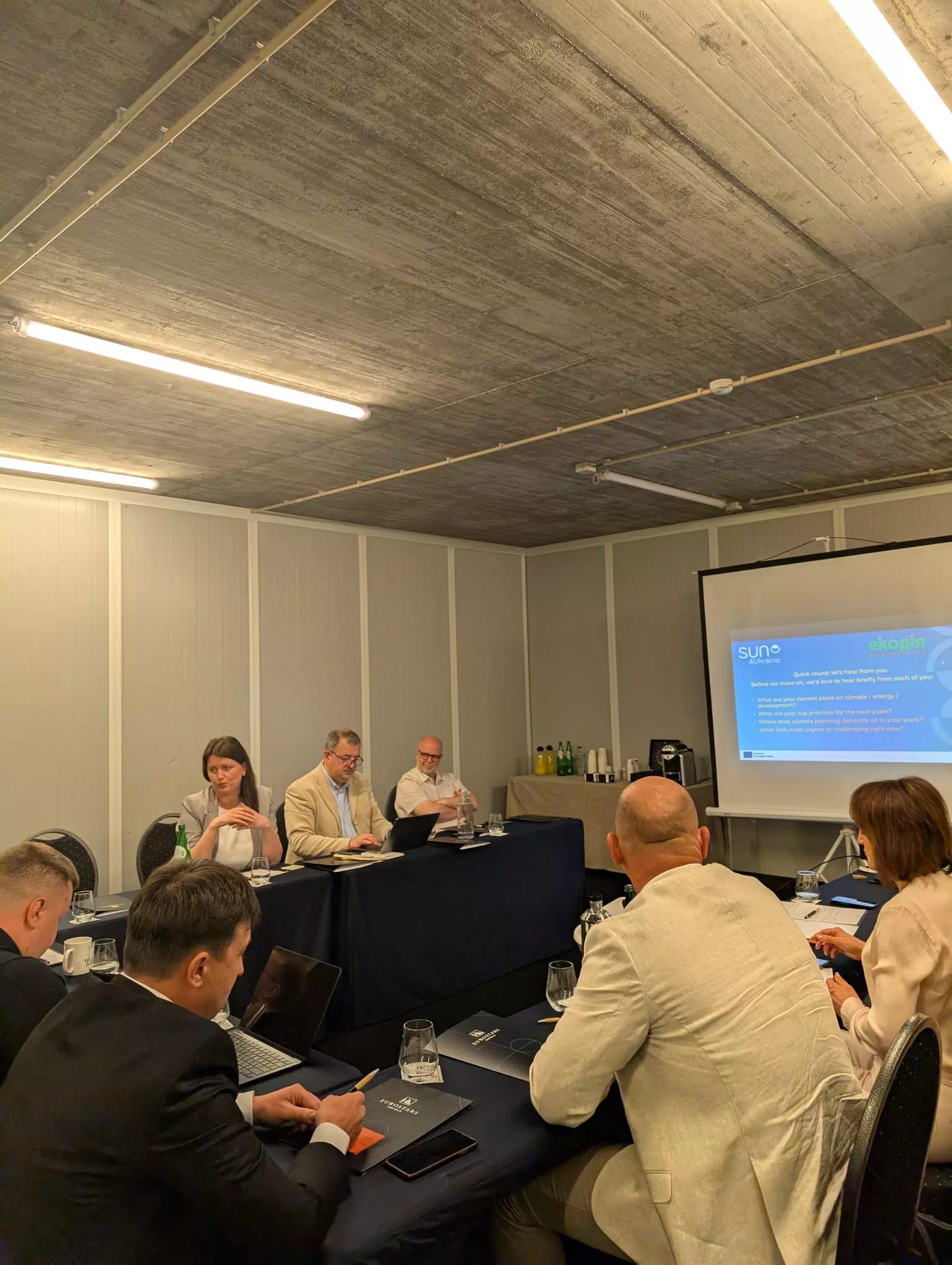
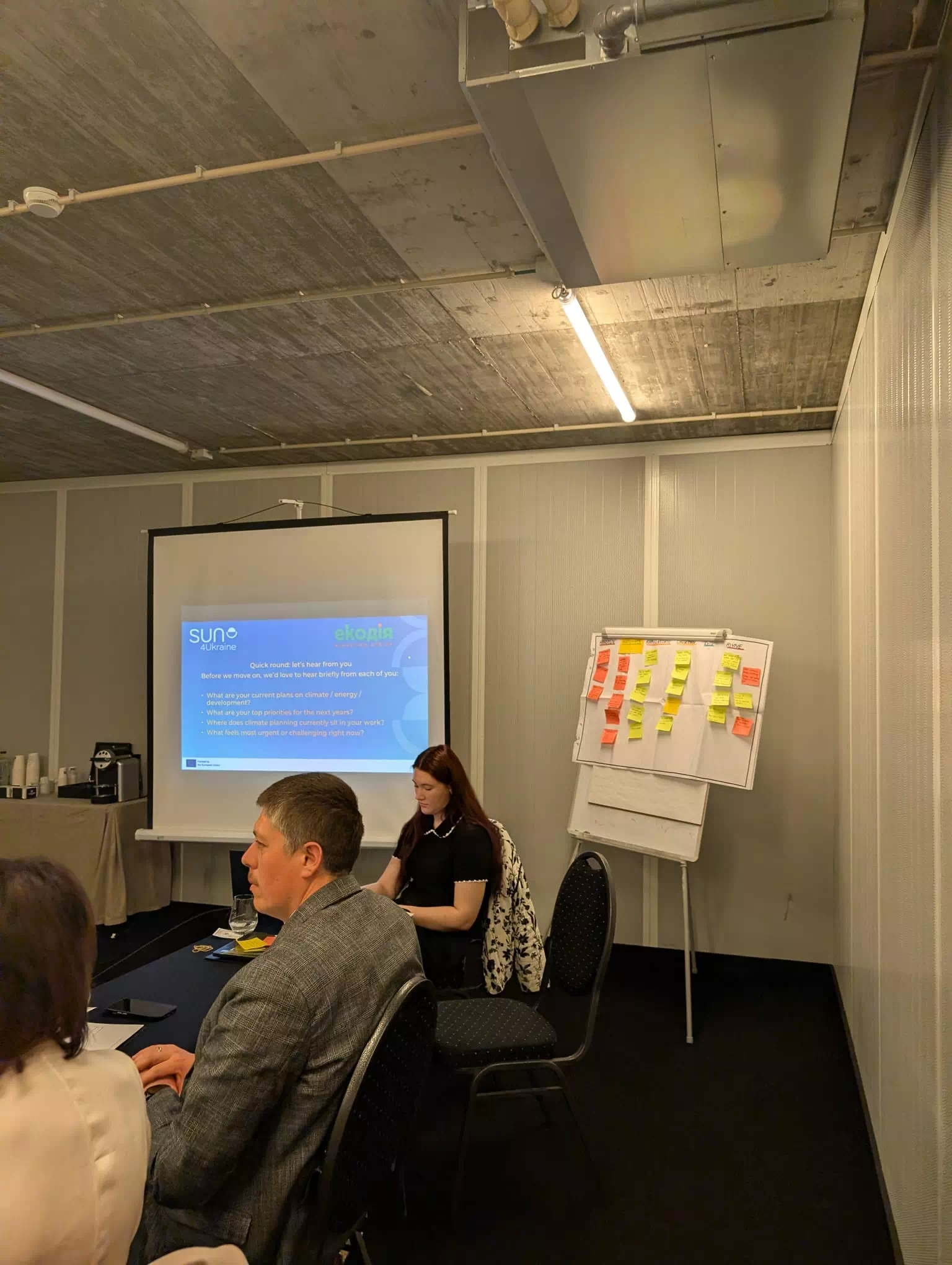
On 28 April 2026, SUN4Ukraine and the Covenant of Mayors East co-organised a workshop during the Energy Cities Annual Forum in Guimarães, bringing together political representatives from Ukrainian municipalities of Krasyliv, Pustomyty, Khmelnytskyi, Chortkiv, Lviv and Rivne.

For Ukrainian cities, the energy transition is no longer just a matter of climate goals, but also of keeping hospitals, water systems, and communities functioning during wartime. Against this backdrop, the session explored how municipalities are advancing the fight against climate change while facing the realities of Russia’s full-scale war in Ukraine and the challenges of reconstruction. The discussion focused on practical experiences: what is already working, what can be scaled up, and what support cities need to maintain the pace of development in the years to come.
Energy resilience and transition in Ukrainian cities
Decentralised energy is becoming a key resilience solution and is also rapidly accelerating solar energy deployment. This has the potential to be developed even further, but Ukrainian cities face a lack of capacity, especially in wartime. Cities described how risks linked to war and infrastructure vulnerability have accelerated investments in rooftop solar, distributed generation, battery storage and heat pumps, particularly for critical public infrastructure such as hospitals, schools and water utilities. Several municipalities shared concrete examples: Ms Nila Ostrovska, mayor of Krasyliv, explained how the Hromada has installed solar stations at a hospital and a water supply company and is currently working on thermo-modernising the hospital. A similar experience was shared by Oleh Serniak, Mayor of Pustomyty, where steady progress is ongoing with the installation of solar power plants on public buildings, with plans to expand further, though limited funding for skilled installation staff remains a key barrier. Beyond energy, the small city is advancing on multiple fronts: a citizen-led river rehabilitation project is in the pipeline, sewage treatment facilities are being reconstructed, and existing SECAPs and Municipal Energy Plans are being strengthened to better integrate climate-related measures into the city's broader development framework.
Chortkiv stands out for its clear and long-term vision: becoming a 100% renewable energy city. Through its “Sunny Chortkiv” programme, Chortkiv’s mayor, Mr Volodymyr Shmatko, explained that this ambition is already taking shape, with around 14 solar power plants installed across the municipality. What makes Chortkiv’s approach particularly strong is the combination of strategic planning and practical implementation. The city has multiple programmes in place, an operational energy monitoring system for public buildings, and a dedicated municipal department responsible for energy management. At the same time, like many smaller municipalities, Chortkiv faces constraints in scaling up particularly due to limited technical staff available to install and maintain renewable energy systems. This highlights a broader challenge: even highly ambitious cities require sustained capacity support to turn long-term visions into fully realised energy systems.
Rivne represents one of the most advanced examples of structured climate and energy planning among Ukrainian cities. Mr Artem Hanushchak, Deputy Mayor of Rivne explained that as the only Ukrainian municipality selected for the NetZeroCities Pilot Cities Programme, Rivne is actively aligning its strategies with national and European climate frameworks. The city combines long-term vision with practical tools. Intelligent energy monitoring systems, smart meters, and the development of a municipal energy data platform are already supporting more informed decision-making. At the same time, Rivne is investing in concrete projects from thermo-modernisation of public buildings to heat pumps and solar installations. Despite this progress, the city still faces staff shortages and is trying to actively mitigate this by sharing its experience and engaging in peer learning with others.
Mr Vasyl Novachok, deputy mayor of Khmelnytskyi also highlighted how Ukrainian cities are building a diverse and robust portfolio of energy and infrastructure projects, even in wartime. The city is simultaneously investing in renewable energy, public transport and water infrastructure, combining different financing instruments to move implementation forward. A 1 MW solar power plant is already operational, and ESCO-based solutions are supporting energy efficiency improvements in municipal systems. At the same time, the city is modernising its public transport fleet, with 44 new trolleybuses planned to be installed with EBRD support. Partnerships with international financial institutions, such as NEFCO, are also playing a central role, especially supporting renovation and reconstruction of schools, kindergartens and water treatment infrastructure. Khmelnytskyi’s experience shows how cities can combine different funding sources and sectors into a coherent development path. However, managing such a broad portfolio requires strong coordination capacity, an area that remains a challenge for many municipalities in Ukraine.
The ambition is clearly there, and all cities have expressed strong political commitment and a clear ambition to do more. In Lviv, one of Ukraine's largest cities and a key humanitarian hub, energy transition efforts are advancing alongside mounting pressure on municipal systems. Mr Serhii Kiral explained how war has directly affected their ability to install renewable energy systems at scale. Shifts in institutional priorities under wartime conditions have led to changes in staffing and organisational structure that affect the dedicated capacity needed for long-term climate and energy planning. Despite all this, Lviv continues to demonstrate remarkable institutional resilience and forward momentum. Energy efficiency and modernisation programmes in social housing are ongoing, and there are large investments in biogas and the installation of heat pumps, despite all the challenges faced.

Data, monitoring, and replication potential
Another major theme was the increasing importance of energy monitoring and access to reliable data. Cities reported progress in deploying intelligent monitoring systems and smart meters, to be better equipped with data which could inform priorities and decisions. Several municipalities are also building partnerships with IT specialists and universities to strengthen digital tools for energy planning. Capacity-building through partnerships was highlighted repeatedly, with cities such as Lviv working with technical universities to equip municipal teams with the necessary skills. Rivne echoed similar examples and emphasised the need for Ukrainian cities to connect and exchange further on current and future challenges, which often require common solutions.
Priorities for future support and peer learning
On this note, participants underlined the importance of scaling capacity building across Ukraine, including through stronger links with technical universities and already existing networks such as Energy Efficient Cities of Ukraine and initiatives such as the Covenant of Mayors East. There was also a clear call to ensure that smaller cities, particularly those with fewer than 20,000 residents, are better represented in future activities, as they face distinct staffing and resource limitations.
Several recommendations emerged from the workshop, including supporting peer learning between cities with advanced experience and those still building their climate planning capacity, clarifying financing pathways, and exploring whether models such as co-generation networks could be replicated elsewhere.
The discussions in Guimarães confirmed that Ukrainian cities are not pausing climate action because of war, they are redefining it under extreme conditions. The SUN4Ukraine project is committed to continuing to extend and enable this through future capacity building activities such as the Ukrainian Cities Climate Hub.